
Shape, border definition, hydration and proportion can be discussed without assuming that more volume is the right goal.
A treatment planned around your face
Dermal Fillers in Dubai
Thoughtful volume restoration and facial balance begin with medical assessment—not a fixed syringe package.
- First step
- Facial and medical assessment
- Approach
- Conservative, anatomy-led planning
- Follow-up
- Review after the result settles

In brief
Dermal fillers are injectable medical devices used to restore volume, refine selected facial contours and soften some static lines. A safe plan begins with facial and medical assessment—not a fixed syringe package—and includes product-specific consent, conservative placement, aftercare and a route for urgent review.
What can be discussed?
Your consultation may explore these areas.
Different products are designed for different tissues and approved uses. Suitability cannot be decided from a trend or photograph alone. The clinician should consider facial proportions, skin quality, movement, previous treatment and the risk profile of each anatomical area before recommending filler—or recommending no filler.
Mid-face support may be considered when there is true volume loss or a structural contour goal.
Projection and lower-face balance are assessed together rather than treating one angle in isolation.
Nasolabial and marionette lines may reflect movement and wider volume changes, so direct filling is not always the only option.
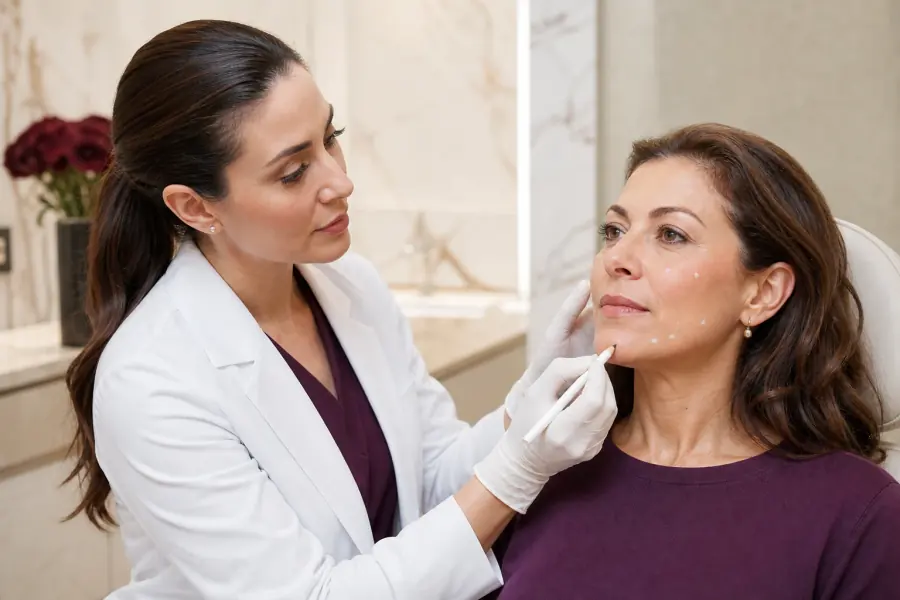
Assessment before treatment
A plan you can understand and question.
The clinician should understand what you want to change, assess your face at rest and in movement, and review health history, allergies, medicines, previous filler and recent skin or dental issues. You should discuss alternatives, the exact product and treatment area, likely limitations, common effects, serious risks and the follow-up plan before consent.
Your goals and the features you want to preserve
Medical conditions, allergies, medicines and pregnancy or breastfeeding
Previous filler, dissolving treatments, surgery or dental work
The treatment journey
Three stages, never rushed.
After consultation and consent, the treatment area is cleaned and may be marked or numbed. The clinician places the agreed product using a needle or cannula, checks symmetry and tissue response, and stops if anything is unexpected. You then receive product details, written aftercare and a follow-up plan.
- 01
Consult
Review anatomy, movement, medical history, previous filler and realistic goals.
- 02
Treatment
Consent and preparation: Confirm the product, indication, amount, alternatives and risks; cleanse and mark the area when appropriate. Conservative placement: The clinician injects slowly with a suitable needle or cannula and continually reassesses the tissue. Immediate review: The treated area is checked for symmetry, skin colour, pain and any unexpected change.
- 03
Review
Receive the product record, aftercare, emergency contact information and timing for review.
The complete guide
Choose the part you need now.
Explore treatment areas, the procedure, results and aftercare, safety, or common questions on focused, easy-to-read pages.
Medical sources
A treatment planned around your face
Ready to talk about fillers?
Start with your goals and medical history. Product, area, amount, risks and follow-up should be confirmed during consultation.
From the blog
Practical answers before your next step

Product questions
Dermal Fillers in Dubai: Ask for a Product Record
Understand the product, proposed facial area and treatment record before filler consent, including traceability and local authorization questions.
Read article
Aftercare and warning signs
Filler Aftercare in Dubai: Bruising or Urgent Warning?
Know why unusual pain, colour change and visual symptoms after filler need urgent assessment, and how to report less urgent concerns clearly.
Read article
Before your appointment
Before Fillers in Dubai: Prepare Your Medical History
Bring a complete history of medicines, allergies, previous injections and current skin concerns to your filler consultation without stopping prescriptions yourself.
Read article
Review and maintenance
Filler Maintenance in Dubai: Reassess Before Repeating
Why a filler review should assess current anatomy, previous products and changing goals instead of automatically scheduling a top-up.
Read article